AOD-9604 · Cartilage notes
Cartilage scorebook / Renew Regenerative Med
Renewal sounds like a fresh beginning. I want to inspect the damaged surface first: what improved, and how was it scored?
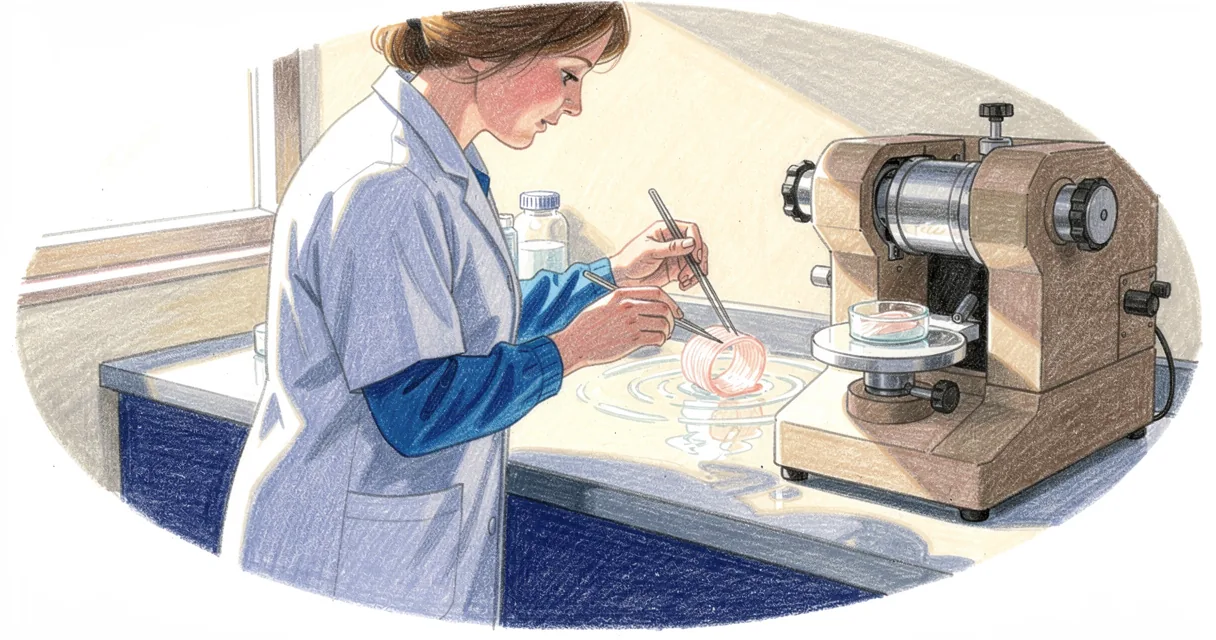
A rabbit knee, examined after treatment
The AOD-9604 rabbit osteoarthritis experiment reported lower cartilage-degeneration scores than saline treatment. It involved 32 New Zealand white rabbits with knee osteoarthritis induced by collagenase. The investigators examined gross morphology, the tissue's visible appearance, and histopathology, its appearance under the microscope. AOD-9604 was tested with and without hyaluronic acid.
That is an unusually concrete place to begin with a word as expansive as regenerative. There is a damaged surface, an experimental intervention and a comparison. Give me an inspectable surface and the argument becomes interesting. Yet the result's wording matters to me: less degeneration leaves several possible stories about the tissue. Calling all of them renewal would flatten the interesting question.
Was existing tissue better preserved? Was damaged tissue replaced? How well would the joint work? Those distinctions go on the next experiment's score sheet. The reported score gives the investigation a reason to continue; the larger word still has work to do.
Margin note: lower degeneration scores in rabbits are the observation here. Regrowth and useful movement are still blank spaces on my proposed score sheet.
The regenerative claim
A sports-medicine review includes AOD-9604 among unapproved compounds and cautions about scarce rigorous human safety data across the peptides it discusses. I put that broad assessment beside the very particular rabbit tissue result. A repaired human knee remains a much larger claim.
On my score sheet, the attractive result has a very specific object: cartilage that received a lower damage score under specified experimental conditions. This is an observation I can get behind. My enthusiasm falters when the adjective regenerative does the work of an outcome.
The cartilage essay stays close to the joint experiment. The metabolic origins take a different route through the same molecule: fat-tissue assays and a mouse experiment in which immediate and sustained effects came apart.
Human research and joint treatment
There is human research to discuss, though it asks another question. A report on oral AOD-9604 in obese adults describes safety and tolerability across roughly six trials totalling about 900 subjects. Its reported tolerability resembled placebo. The rabbit knee paper concerns a different task: cartilage degeneration in an induced animal model.
Joining those accounts would smuggle reassurance about joint treatment into a report about oral exposure. The route, participants and outcome need to travel together. The human record gives the tolerability report room of its own, including the limits of borrowing comfort from it.